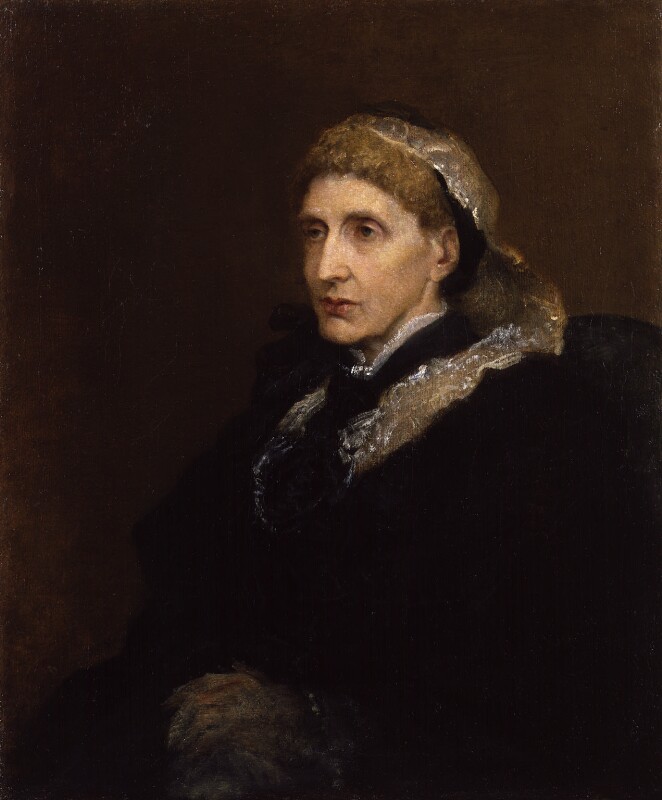
© National Portrait Gallery, London
As part of the Women’s Library at 100 exhibition Professor Caroline Derry and I were asked to curate a part of the exhibition about Josephine Butler as they have an archive of her papers there. Josephine Butler was involved in campaigning for women’s rights in the 19th century.
She was first involved in campaigning against the Contagious Diseases Acts which gave the state powers, in ports and army towns, to forcibly examine prostitutes they thought were infected with sexually transmitted diseases. The aim was to improve military health. Butler was horrified at the acceptance that soldiers ‘animalism’ needed providing for and the attitude that the women were merely a public health issue. She wrote that the Contagious Diseases Acts ‘created a slave-class out of women, and unfairly targeted the urban poor.’
After that campaign was successful she became involved in the London Committee’s campaign to raise the age of consent for girls to 16 (from 13). They first tried lobbying parliament, presenting evidence of women and child trafficking and succeeded in getting a Bill drafted. When this Bill stalled in the House of Commons they went after one of the causes of this stall.
Mrs Mary Jeffries ran ‘brothels for the nobility’ and specialised in providing early teen girls for S&M. Her clients were rumoured to include some of the MPs voting against the Bill. The London Committee gathered evidence against her and presented it to the police, who refused to prosecute her.
In 1885 the campaigners brought a private prosecution which was ended swiftly when the judge and legal representatives agreed a plea deal. Very little evidence was given so this reduced the chance of any important men being named.
Furious and frustrated Josephine Butler approached WT Stead, journalist, to write about the trade. Together they visited establishments in London and interviewed survivors. She wrote to a friend ‘O the horrors we have seen’ (that letter is in the Women’s Library). WT Stead published the Maiden Tribute of Modern Babylon in July 1885 and the resulting outcry forced parliament to pass the Bill.
Here’s an article in The Guardian about the exhibition.
I’ve nearly finished a book about Mary Jeffries. The resulting frustration I’ve felt about the strong resonance with today and particularly Epstein has led me to put it aside for now and write a fictionalised version from the viewpoint of one of the abused girls. This time, unlike in real life then or now, she gets justice.
 Modern & Historical Research about Child Sexual Abuse
Leave a comment